
How to Make Family Entertainment More Engaging Without Relying on Screens
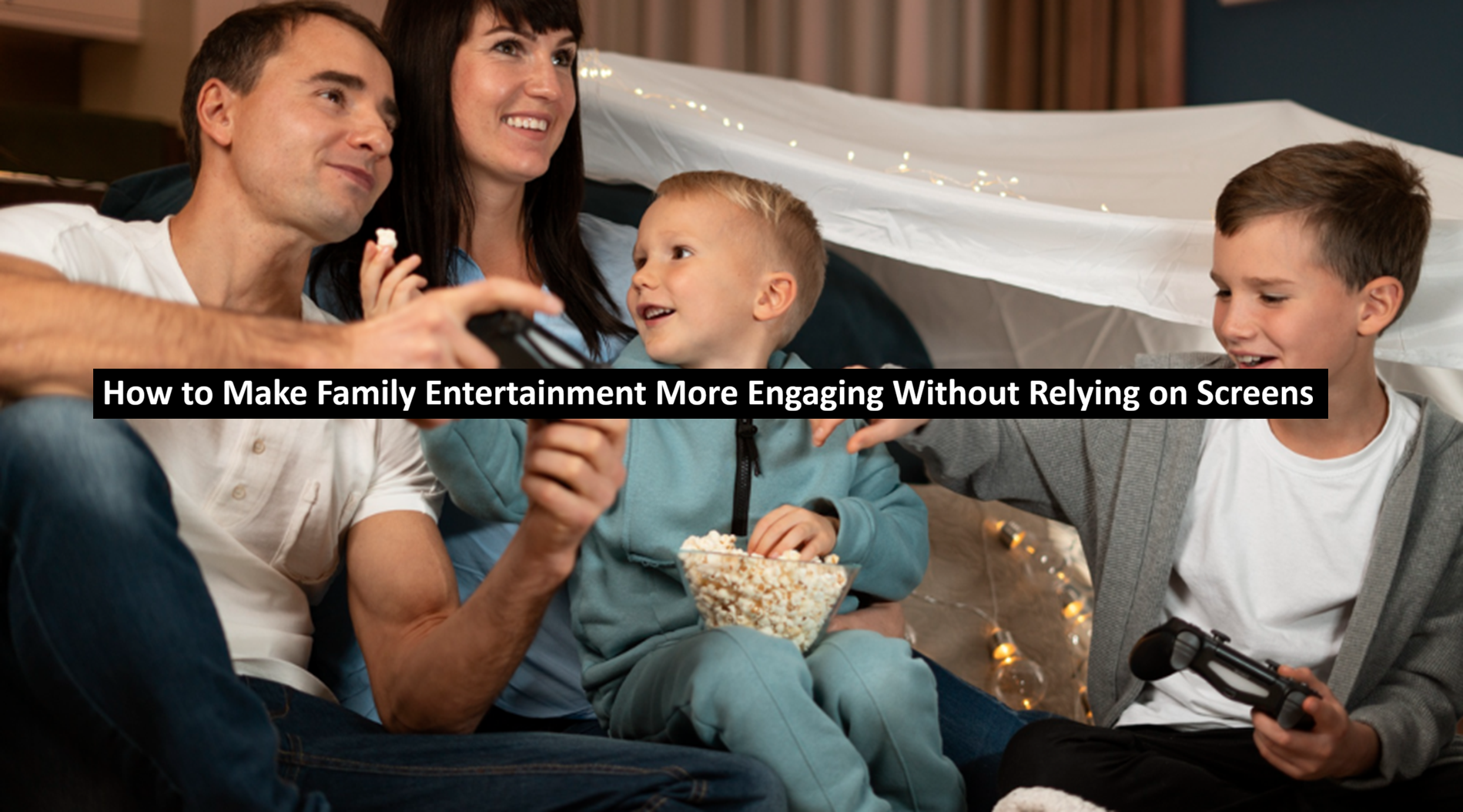
Family entertainment doesn’t have to start in front of the television, on a tablet or on a phone; many of the most positive and enduring family memories derive from activities which prompt talking, movement, creation, competition and fun. For parents and carers, it isn’t usually the difficulty in finding activities that’s the issue; rather it’s a need to make non-digital play enticing so that everyone enjoys taking part.
This is relevant at an age when the Television Market, and the digital entertainment market as a whole, is rapidly changing, allowing for endless on-demand access to content. Digital media offers a unique source of both entertainment and education and the potential for family connection; however, it also vies with, and potentially detracts from, play, physical activity, conversation and family quality time. A useful guide published by The American Academy of Pediatrics emphasizes a Balanced Family Media Plan that includes time for activities such as reading, outdoor play, games and hobbies.
The aim then need not be for families to cut down on screen time but to ensure that non-screen activities are also varied, social and enjoyable.
Why Screen-Free Entertainment Can Be Valuable
But you’re Entertainment has different functions: it provides fun, and it can do more. It can facilitate social interaction, create scope for imagination, physical activity, or it may teach you new things. Take this example of children’s leisure time: it helps young ones explore and understand the world around them, and with play, they gain social and practical skills and stimulate imagination.
UNICEF, on its website, discusses that play “is an important vehicle for developing children’s curiosity, imagination, relationships and physical strength.”
Playing offline entertainment enables different kinds of communication compared to passively watching Television. A family board game gives participants the space to interact and to give feedback to each other; cooking will require collaboration; even going out can initiate conversations between and between them. Even playing storytelling games will train kids to pay attention, remember information, and create imaginative ideas. Such activities do not even need to be of formal academic purpose, but the interaction is itself rewarding.
Read: How to Choose the Perfect Music Playlist for Any Celebration
Start With Participation, Not Perfection
One thing people believe is that it may have to involve large efforts. It really does not. Complicated fun involving cost and paraphernalia will not do nearly as well as it is for it to be simple but understandable straight away; a first-class family activity generally requires few props and total member participation.
Give the family a challenge based on household items – for example, have one person select five items, and the rest write a story that incorporates them, or have each person take 3 minutes to build anything out of cardboard, paper, or construction paper.
You are not necessarily aiming for a great finished product, only a situation where everyone participates. This last point is especially critical in family activities with children. If a game feels more like a lesson, children lose interest immediately. If it feels like an exploration together, though, everyone is more willing to join.
Turn Ordinary Activities Into Games
Everyday chores could become some type of enjoyment when combined with a component of choice, curiosity, or wholesome competition. For instance, preparing dinner could grow into a trial that entails sampling flavours; a stroll through your block might flip right into a quest for recognizing plants and flora. Sorting and organizing a room could evolve into a competition against the clock, whereas a journey to a small local park might now offer you and your family members an enriching sport of looking and finding…
It does not necessarily signify that the exercise will be the identical; nonetheless, the presentation may well have transformed. A team could set themselves challenges using finding five distinctive leaf kinds during the duration of a walk, devise the most entertaining nicknames for your new recipe, or narrate an account involving any 3 arbitrary domestic objects. Making the top towers out of recycled contents can bring home some stimulating playtime, whilst participating in animal sounds offers your young kids the simple enjoyment of partaking in an indoor sport.
This tactic is especially useful considering these actions can require family members not to use a significant amount of specialized online games.
Imagination gets to be the significant resource.
Make Family Games More Dynamic
Although board games and card games are traditionally great family entertainment, these activities themselves can become just as boring as each other after repeated playing.
As another option, family members could invent a way of varying a standard game that will not be too difficult for the younger children. For example, for a standard quiz, family members could think up their own set of quiz questions for the quiz. Younger members could come up with picture questions or older children with very difficult questions.
Another activity could be to spread activities over two or three nights and turn the activity into a tournament within the household. Here members can receive points for completely different activities which are all varied, from the card game to drawing to general knowledge to a physically challenging activity.
This gets people’s thoughts on things in, and takes away the reliance on a screen for something exciting to happen.
It may also be useful whatever the activity it is fitting. A completely competitive activity might really get one family going, but really upset another. Alternatively, they may prefer teamwork, as such activities are quite important.
Is it that there will be some activity that will give them thrills?
Use Stories as a Source of Entertainment
Storytelling: One of the most adaptable types of entertainment for screen-free families since it has very minimal required equipment. A parent can share from personal history; children can conjure imaginary characters and situations. Or, a family can collaboratively work towards one common story whereby individuals contribute to a sentence or the direction of the narrative.
What Would You Do stories are a fantastic type of storytelling whereby one initiates a scenario like finding a unique box in the back garden and family members take turns deciding what the outcome is, which leads to engagement of thought with one another and opportunity for them to practice expressing their thoughts and ideas in a manner that is not task-like.
This can lead to open-ended dialogue with family and stimulate creative thinking. Reading and books can be utilized similarly. The child does not necessarily have to listen to an adult read the story but, rather, can engage as a partner in the experience, through identifying elements, anticipating outcomes, or creating their own ending to the story.
Understanding Changing Entertainment Habits
The changes in the way families consume entertainment are determined by the global trends in technological development, the availability of media, and the lifestyle choices of the household. The research desk of Expert Market Research can help understand the global patterns of consumer behavior and the trends in the entertainment industry. Such data should be analyzed through the prism of demographics, considering the ages of family members, their interests, level of accessibility of various forms of media, and the amount of leisure time.
These wider trends partly explain why screen-based entertainment is such a convenient choice, but convenience does not necessarily dictate what makes an experience valuable. A cooperative and communicative family activity provides an alternative type of engagement to content primarily designed for individual consumption than what screen-based entertainment offers.
Give Children Some Control
Children become more involved with entertainment when they have some control over the evening. Family game night might no longer mean parents decide every single game. The evening task could rotate through families.
One night a child chooses which game to play, another night one child chooses which restaurant or place to visit or which meal to serve (perhaps together with family participation).
Adults who always seem to organise need not dominate if given a chance to play on equal terms. The feeling of owning their contribution may make things easier for children used to a lot of personal choices that digital media may afford them. Many online sources do make choices for kids on the immediate-use level, and children may initially resist an offline activity over which they may have little control. Ownership will make a difference.
A child can be responsible for preparing a trivia game, for creating a treasure hun,t or perhaps for choosing three ingredients for family dinner.
Responsibility is easier for a child who is old enough to be expected to train an even younger sibling in a new game, or to help plan the itinerary for a weekend family activity.
Do Not Underestimate Boredom
Boredom is often seen as something that must be gotten rid of as quickly as possible. Yet all the unstructured time can be an invitation to children to create their own forms of entertainment. UNICEF recognizes the value of free play and gives examples of low-tech activities that can foster imagination, curiosity and social interaction.
Obviously not all children will immediately start playing creatively the moment a screen goes offline.
Some may indeed protest that they have “nothing to do”. This can also be part of the transition. Parents may suggest a few activities without specifying how children should play. The arts, building toys, books, puzzles, outdoor toys can be a starting point.
Gradually, we hope, children become more used to creating their own fun rather than consuming that provided by others.
Create Screen-Free Rituals
Family time activities that are incorporated into an established routine may be more successful. A family may choose to designate a Family Game night each week, a walking tour each Sunday afternoon, an informal family Cooking Challenge once each month,h or a weekly storytelling routine. Families could commit to a non-device family dinner either on an everyday basis or every week.
The task does not really have to take several hours of time and/or attention, but rather routine may be far more imperative than length of time.
Screen-free family dinners could potentially be utilized as beneficial time as part of the family to have family members participate. Identifying times as well as places for devices away from family meals may help family members concentrate on individuals.
A Broader View of Family Leisure
Informes De Expertos is another research-based source that studies changes in the market and shifts in consumer trends in various industries. The data analysis from these sources can aid in understanding the general environment in which the family makes choices about home entertainment options, but it cannot predict the preferences of an individual.
Of course, circumstances are also a determining factor. There may be different options available to an urban family living in a city flat from one who has a garden or land on their doorstep, while parents with two-year-olds would find a totally different day exciting than they did when they were teenagers in a house. The choices are affected, also, by lifestyle interests and spending power as well as by time and the possibility.
Thus, there is no universal set plan for enjoyable screen-free activities.
Remember That Adults Set the Example
Kids are observing how adults use technology. If the parents say no phones for dinner but keep checking messages during dinner, kids won’t be too impressed. We can show kids that a family member leaves devices out during collaborative activities.
A good message would be this isn’t what we do; this is not how we are supposed to behave in an ideal world!
An adult shows children that while there is tech in the mix, it will be one part of many instead of a device always jumping to take over a few seconds. In addition to that, a parent or caregiver jumping into a game, chatting to kids, writing stories,s and planning an outing would be a better indicator for the kids than simply dictating them to put their devices away!
Family Entertainment must be actually and fully shared to really work its purpose.
Avoid Turning Screen-Free Time Into a Punishment
There’s an interesting psychological difference between the approach – ‘you can’t play with your tablet now, so go and read a book’ and…’ so what shall we do together this evening?’ One approach views offline activities as a punishment; the other views them as an opportunity. When screen-free nights are due to behavioural issues, your child will associate offline fun with punishment.
Instead, the family might set down some consistent offline time for all family members.
Children feel more included if they are part of the planning process of when, and how much screen time the family engages in. Screen-free time can also be presented not as yet another arbitrary parent imposition but as sacred time to eat, sleep, chat, and play together.
Adapt Activities to Different Ages
As families have children of different age groups, it may be difficult for them to come up with activities that interest every member of the family. One of the most frequently offered suggestions for solving this problem is to assign different roles to members in the same activity. A young child could simply try to find things during a treasure hunt, while an older sibling can read clues.
One might get the young child to help mix the ingredients while the older child gets the precise recipe instructions from a cookbook.
A child could start the story, and the older child adds to the plot and story details. One may be allowed to have more freedom and flexibility in the games. Most important of all is that one should not expect everyone to love the same thing. Every member would have some interest and by providing different entertainment to suit different interests, then all will surely find something to have a time to get enjoyment.
Technology Does Not Have to Be the Enemy
This doesn’t mean technology is always a “bad” thing. In our homes and in schools and out in the world, technology can support learning, social interaction, and imagination. A far more helpful question is what technology is displacing, and how.
A family may well have both online and on-the-couch entertainment.
We watch a nature program about bears, then go for a nature walk. Or we download music to play, then play it ourselves on real instruments. We look up a recipe online and then make the food together. In these instances, technology leads, but doesn’t consume all of our time.
A Practical Way to Get Started
Families do not need to tackle a completely different activity all at once. First, identify one part of your week where everybody can contribute to a screen-free family event. Keep this first activity fairly simple.
Just going on a walk, playing a card game, cooking together,r or a round of story charades may just be the start.
Then examine what did and did not work. Were the family play sessions too competitive, too difficult for young members of the household, did everybody feel they had a role, was a 40-minute session enough or perhaps the ideal, how much did individual members of the family actually enjoy the family activity? Apply that information to design the next screen-free event for the entire family.
Looking Ahead: Making Entertainment More Human
With evolving consumer technologies and enhanced levels of personalization, accessing individualized content will only grow. Families will have more choices than ever before to play, consume media, and communicate digitally. The future of family fun doesn’t have to be an all-out showdown between technology and the “old days.”
Family members can also be mindful of carving out time to enjoy activities that technology cannot offer or replicate to its full potential, such as casual and easy conversations, activities that involve physical play, laughter, and the opportunity to create and explore together, and the ultimate satisfaction of completing tasks together.
The greatest family entertainment comes not from the cost or high-tech device, but from a particular purpose or goal that drives participation. When families engage in activities together like talking, playing, exploring, and working collaboratively, and also creating things, they become an essential part of building and maintaining relationships rather than just killing time. So rather than just reducing time spent watching a screen, take full advantage by creating the possibility to truly coexist.
Author’s Bio:
Roshan Kumar writes about changing consumer habits, family entertainment, technology and emerging media trends, with a focus on presenting complex topics clearly and practically. He has a particular interest in the Television Market and the ways changing media consumption patterns influence households, audiences, and family life.